
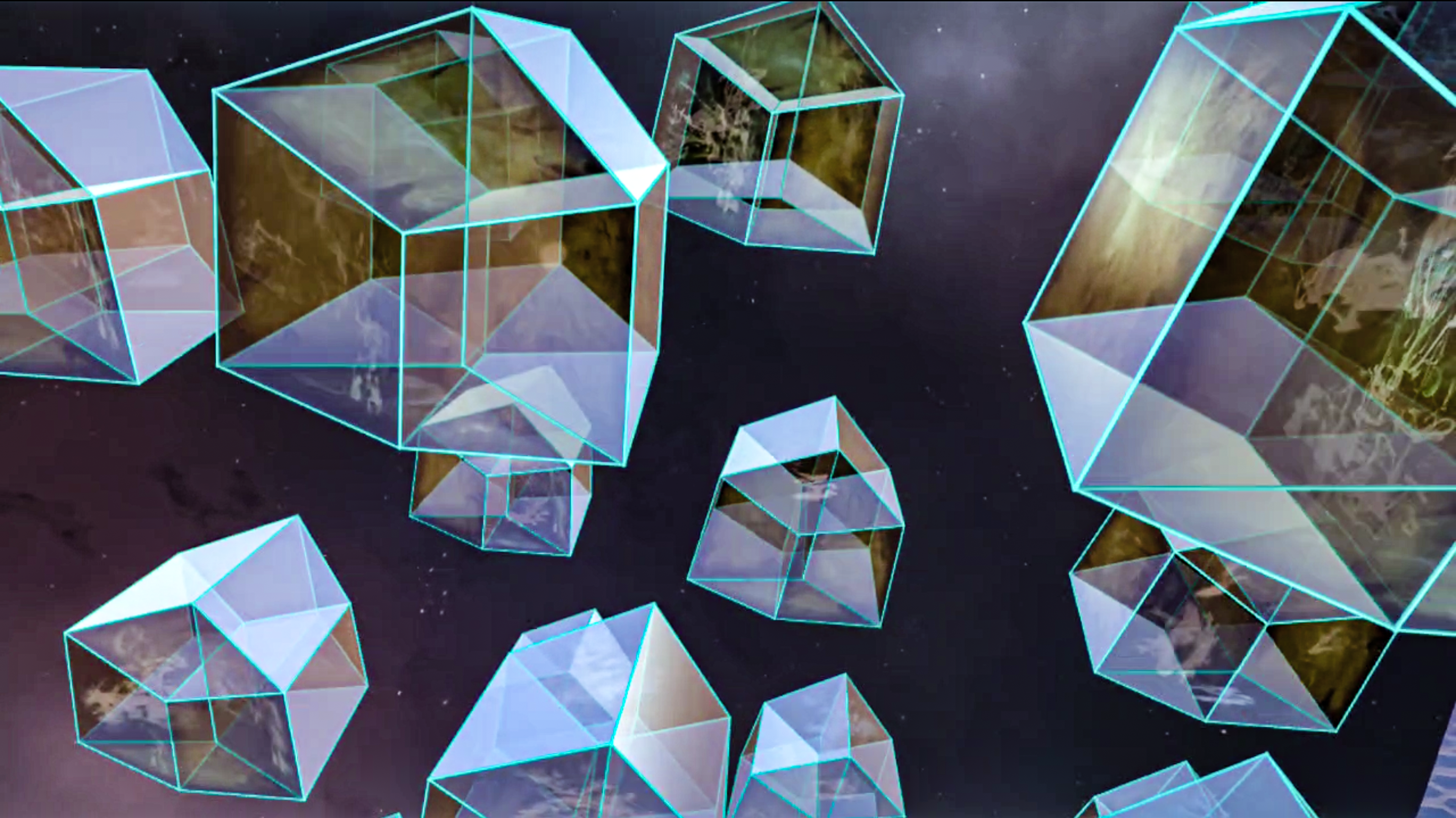
In Between Cubes places the viewer inside an infinite three-dimensional lattice of rotating four-dimensional hypercubes. Each tesseract is a mathematically accurate real-time projection of a 4D object into 3D space, continuously rotating through its fourth spatial dimension. The faces of each tesseract display sequences of photographic images that deform dynamically with the geometry — imagery woven into the fabric of a higher-dimensional structure.
The visual and material content of the work grows directly out of an earlier project, Tales of Two Pebbles. Two stones discovered while digging a planting hole in my backyard — their smooth forms shaped by millennia of water, ice, and sediment — became the source material that now inhabits the virtual architecture of this piece. The surface of one pebble was 3D-scanned to extract both its geometry and its texture; this data forms the skydome of the VR environment, so that the viewer floats inside a space of ancient stone. The other pebble had a life-model figure drawing made directly onto its surface. A time-lapse video of that drawing coming into being — the slow, deliberate emergence of mark from hand — was then applied to the deforming faces of the tesseracts. As the hypercubes rotate through four-dimensional space, the drawing stretches, folds, and reconstitutes itself across their surfaces, expressing what Tales of Two Pebbles sought in a different medium: the mystical sensation of time passing, of something forming and dissolving simultaneously.
Where Tales of Two Pebbles explored time through found objects, hand-drawn animation, and the immortal rhythm of Bach's Cello Suite No. 1, In Between Cubes carries that same inquiry into a higher-dimensional space. The geological time compressed into a pebble's sediment layers now appears refracted through the mathematics of 4D rotation — the stone's surface deforming across faces that fold through each other and re-emerge, in a space the body cannot inhabit but the imagination can navigate.
Navigation is controller-free, relying on a custom swimming locomotion system that lets the viewer float through the gravity-free lattice with natural hand gestures. 3D spatial audio anchored dynamically to each tesseract's geometric centre creates an ever-shifting soundscape that reinforces the viewer's sense of moving through something vast and alive. Atmospheric fog at 200 metres dissolves the array into a luminous haze — evoking, like the stones themselves, the experience of depth that exceeds what the eye can fully reach.